Clients often believe a salon blowout looks better than theirs because the salon dryer is hotter. The opposite is closer to the truth. Professional blowouts look better because of technique: hair dried in the right order, under brush tension, with airflow aimed down the strand, finished cool. Heat plays a supporting role, and when it takes the lead, at home or anywhere, the price arrives as dryness, breakage, and color fade. Learning the professional sequence lets you get most of the salon result at home without cooking your hair to get it.
This is the process stylists in salons like the ones in Matthews use, translated for a home bathroom and an honest schedule.
Preparation decides most of the result
A blowout starts at the sink. Clean, well-conditioned hair dries smoother than hair carrying two days of product, and a leave-in heat protectant is not optional equipment; it is the buffer between the dryer and everything you have grown. Apply it evenly, detangle gently from the ends up, then remove most of the water before the brush appears. Rough-drying with just the dryer and your fingers until hair is mostly dry, around eighty percent, cuts the brush-and-heat time dramatically, and less time under tension and heat is the whole game.
- Protect and detangle. Heat protectant through damp hair, detangled gently from the ends upward.
- Rough-dry first. Dry with fingers only until hair is about eighty percent dry.
- Section properly. Clip hair into four or more sections; work one at a time, keeping the rest up and out of the way.
- Tension and direction. Round brush pulling the section smooth, dryer nozzle aimed down the strand from roots to ends.
- Finish each section cool. A cool shot sets the shape; move on only when the section is fully dry.
- Hands off until cool. Let the whole style cool before touching, separating, or judging it.
Temperature discipline
More heat is not more smooth; past a point it is just more damage per pass. Use the lowest temperature that, combined with brush tension, dries and smooths the section in a few passes. If you need six passes at high heat, the problem is usually technique or a section that is too large, not insufficient temperature. Fine and color-treated hair deserves the cooler settings and fewer passes as a rule, because both are structurally easier to damage. The dryer should keep moving; holding hot airflow on one spot is how scorching happens.
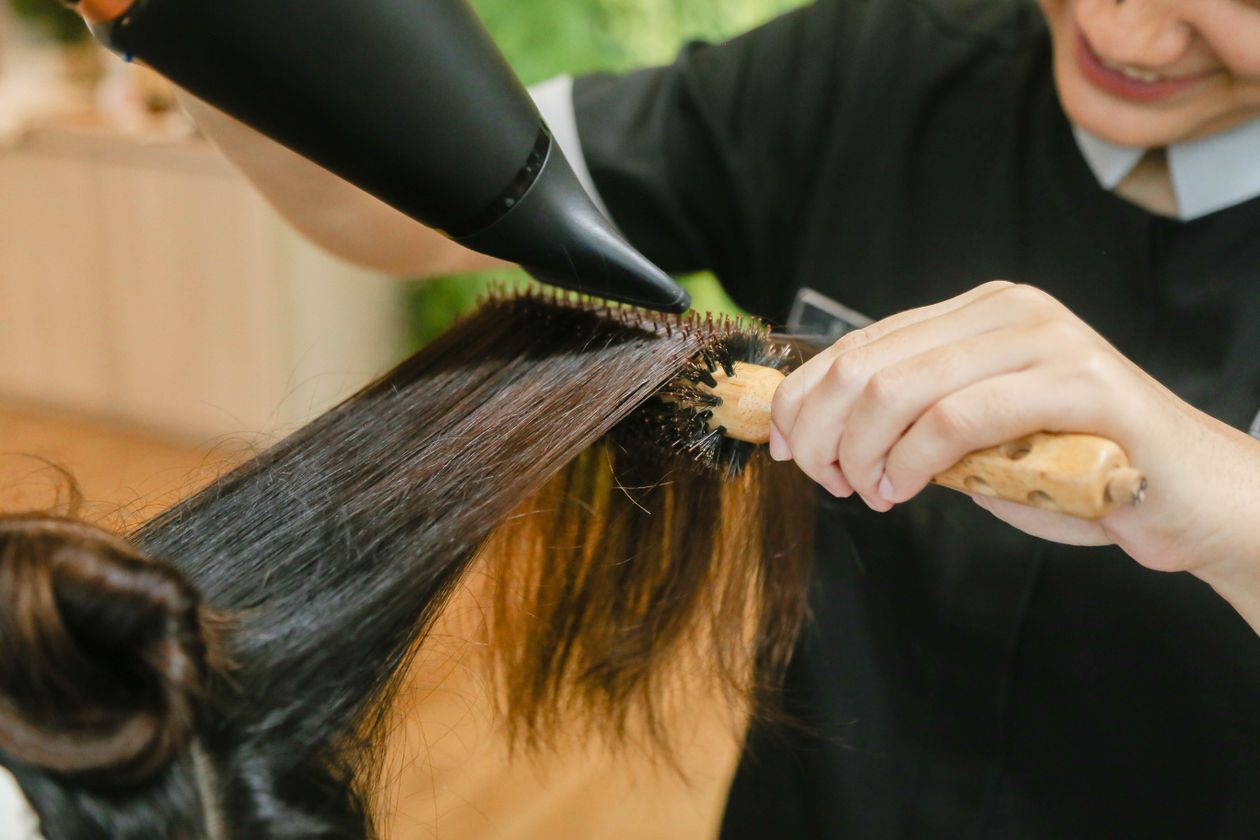
Direction is the quiet secret. Hair scales lie pointing from root to tip. Airflow aimed the same way lays them flat, producing shine and smoothness. Airflow blasted upward or randomly roughs them open, producing frizz that people then try to defeat with more heat, which makes it worse. The nozzle attachment on the dryer exists for exactly this: concentrating air into a directed sheet. If yours fell off years ago, replacing it will improve your blowouts more than a new dryer will.
Making it last in Carolina humidity
A Matthews blowout then meets its real opponent: humid air looking to re-enter the strand. Fully dry hair is the first defense, because hair left five percent damp will frizz at one hundred percent efficiency. Let the style cool completely before going outside, apply a light anti-humidity finisher sparingly, and keep hair up or covered during the most humid errands. At night, a satin bonnet or a loose high ponytail preserves the shape, and most blowouts hold two to four days with that protection.
Know the cumulative math, too. A careful blowout once a week, with protection and moderate heat, is well within what healthy hair tolerates. Daily re-styling of the same hair with hot tools is how damage compounds, because the ends never recover between sessions. Salon clients who stretch a professional blowout with good night care are not just saving time; they are giving their hair the rest days that keep it strong enough to keep blowing out beautifully.
Tool condition plays a quiet role as well. A dryer with a clogged rear filter runs hotter and weaker at the same time, which tempts you into longer sessions at higher heat. Clean the filter monthly. Brushes matter too: a round brush sized to your hair length grips and smooths better than an oversized one you fight with. None of this is glamorous, and all of it shows up in the mirror, which is rather the point of technique in the first place.
Common questions
Why is my home blowout frizzy when the salon one is not?
Usually three causes: sections too large, airflow aimed the wrong way, and hair that was not fully dry. Fix those before blaming your dryer or your hair.
How hot should the dryer be?
The lowest setting that smooths the section in a few passes with good brush tension. Fine or color-treated hair should stay on the cooler side.
How long should a blowout last?
Two to four days is typical, extended by satin night protection and humidity discipline. Sleeping unprotected on cotton shortens it fast.
Photos in this guide are representative stock images.
← All guides from StudioEast Styling Salon← Back to StudioEast Styling Salon